For Project/Site Managers and concrete contractors, pouring in hot, dry or windy weather: the curing plan you lock in before pour day decides how your slabs perform for decades.
It’s 11am. The pump has packed up and a dry, gusty wind picks up across the slab. By mid-afternoon, fine cracks are showing.
The mix was right and the crew was good. The weather simply pulled water out of the surface faster than the concrete could replace it.
Days like that turn up every summer. The answer is a plan made before pour day, not on it.
El Niño 2026–27Both sides of the Tasman have declared El Niño. The Australian Bureau of Meteorology (16 June 2026) says most models indicate the event is likely to be strong to very strong, while warning that the exact summer impacts remain uncertain. Earth Sciences New Zealand (2 July 2026) expects stronger westerlies and an increased likelihood of dry conditions in northern and eastern regions. |
- RELATED READING: Summer Curing
Why the first hours matter
Fresh concrete bleeds water to its surface. Plastic shrinkage cracking happens when the surface dries faster than that water arrives.
The useful measure is evaporation rate: kilograms of water lost per square metre per hour (kg/m²/h). It depends on four things: air temperature, concrete temperature, relative humidity and wind speed.
In the US, guidance advises caution once evaporation exceeds 0.5 kg/m²/h and calls for precautionary measures above 1.0 kg/m²/h (FHWA). But a hot, breezy morning could pass that before smoko.
Early drying also stops hydration near the surface, leaving a weaker, more porous top layer: the one that must resist wear and moisture for decades.
 |
What helps on the day
- Time the pour. Early morning or evening avoids the worst heat and wind.
- Talk to your supplier. Ask about hot-weather mix adjustments.
- Shade and shelter. Shading concrete from direct sun can cut evaporation by up to half (IJCE). Windbreaks help too.
- Start curing early. In hot weather, “after lunch” is too late.
The MARKHAM approach
Water curing works, but needs labour, attention and a reliable water supply, which can be scarce in a dry summer.
Spray-applied hydrogel curing forms a temporary surface film, then draws moisture into the concrete to support hydration from within.
CONQOR CURE is MARKHAM’s spray-on hydrogel curing treatment. Independent testing by Cement Australia found its curing performance equivalent to both water curing and an AS 3799 film-forming membrane.
It can go on in two stages: a light coat during finishing as a finishing aid, then a full coat once the surface is ready. It leaves no residue to grind off. The treated slab can be accessible within a few hours, subject to the concrete and site conditions.
Apply it as soon as practically possible or within the curing window, usually the first 24 hours, and in hot weather as early as the surface allows. (a)
- RELATED TOPIC: The Concrete Curing Cost Nobody Quotes For
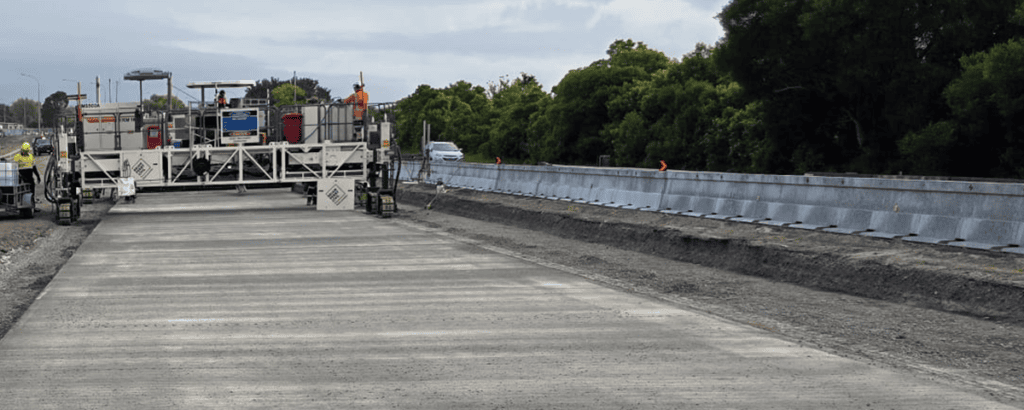 |
| CONQOR CURE in use on the Hawkes Bay Expressway project. |
Questions worth asking before your next pour
- What’s the forecast evaporation rate for pour day, and who’s checking it?
- How soon after finishing will curing start, and who applies it?
- Is water curing realistic if water restrictions apply?
- What coatings, adhesives or toppings follow, and is the curing method compatible?
Talk to us before the curing method is locked in
From warehouse floors and car parks to data centres and general flatwork, we can help build hot-weather curing into your method statement. Talk to a MARKHAM concrete curing specialist.
(a) NOTE: CONQOR CURE is not suitable for coloured concrete.
WEBINAR | Wednesday 11 November 2026Doug Hamlin and Charles Currie discuss the topic “What is your concrete curing method really costing you?” Full agenda and registration here! |