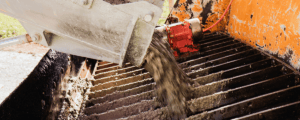
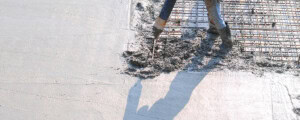
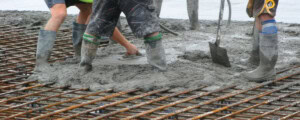
Higher SCM content can reduce cement dependence.
The challenge is maintaining early strength, pumpability and finishability when conditions change.
For ready-mix producers moving to higher-SCM concrete: lowering cement is one challenge. Maintaining early strength and practical workability is the test.
The low-carbon mix is approved. Slag replaces a large share of the cement, the EPD looks good and the client is happy.
Then winter arrives. Strength at stripping is behind, the finishers are waiting, and the pump operator says the mix feels sticky. Next time, someone quietly adds cement back in.
That’s the real barrier to SCM adoption. The intent is there. Performance on the day is what’s in question.
Why high-slag mixes behave differently
GGBS (ground granulated blast-furnace slag, a by-product of iron making) reacts more slowly than Portland cement, especially in cold weather. Early strength lags, which affects formwork stripping, saw-cutting and the programme.
Slag-rich mixes can also feel sticky, which makes pumping, placing and finishing harder. Neither problem means the mix is wrong. It means the mix needs help in its first hours and days.
 |
The usual workarounds
- Add cement back in: restores early strength, but negates the carbon savings.
- Drop SCM content in cooler months: practical, but caps the reduction year-round.
- Accelerators or heat: can help early strength, but don’t address workability, and may add cost or complexity.
Each tactic trades away part of what the low-carbon mix was meant to achieve.
- RELATED READING: 7 Challenges When Working with High-Slag Mixes
The MARKHAM approach
Colloidal silica is made of nanoscale silica particles. In fresh concrete they act as nucleation sites, or “seeds” for hydration, speeding up the early reaction of cement and slag. They also promote early formation of C-S-H, the binding “glue” in cement paste.
CONQOR A6 is a liquid, colloidal silica-based admixture designed for slag- and SCM-rich mixes.
CONQOR A6 works on both problems:
- Early strength: it accelerates early hydration in slag and blended cement concrete, supporting the use of GGBS concrete at lower temperatures, without negative impacts on overall strength, drying shrinkage or permeability at equivalent water/cement ratios.
- Workability: it is thixotropic, meaning it is stiffer at rest but flows well when pumped, vibrated or screeded. This helps counter stickiness and supports placing and finishing.
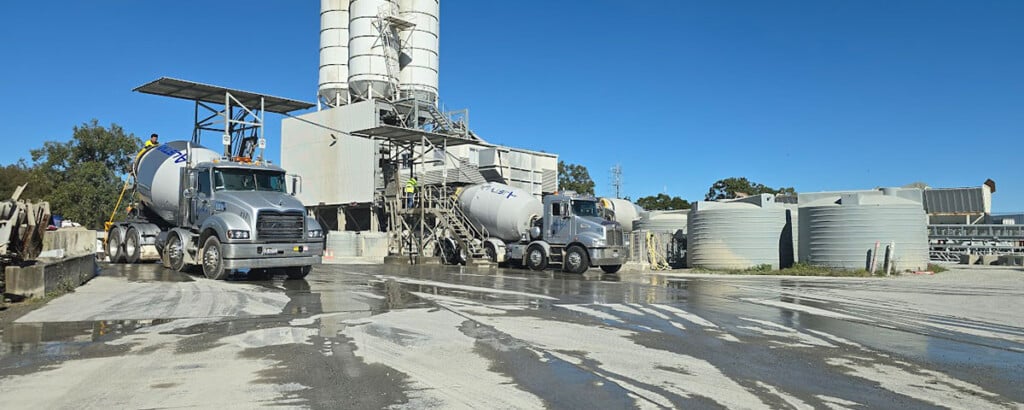
It is compatible with most SCMs and admixtures, and can be supplied in bulk with plumbed-in dosing for consistent batching.
 |
What does that look like in practice?
In trial mixes, CONQOR A6 has been assessed against untreated control mixes for early strength, workability and longer-term concrete properties. Ask MARKHAM for the relevant test data for your mix conditions, or send us your mix design to establish an appropriate trial.
Questions worth asking
- What happens to your early strength when the temperature drops?
- When a high-SCM mix struggles, what do you change first, and what does it cost in carbon?
- How do your pump crews and finishers rate the mix?
- Could an admixture let you hold SCM content year-round?
Talk to us before the mix design is locked in
Developing or reviewing slag-rich mixes for ready-mix or precast? Send us your mix design and specification to discuss trials with your materials and mix.
Specialist Admixtures: Helping ready-mix producers transition to high-SCM mixes.
For more depth, watch the on-demand webinar, “Accelerating Early Strength in GGBS Concrete“.