For hospital builders, project managers and specifiers: the curing method used on pour day can determine how much grinding, delay and risk sits between the slab and the vinyl.
The slab went down months ago. It was cured, it tested well, and everyone moved on. Now the flooring contractor is on site with a grinder, and the program is about to slip.
Hospitals feel this more than most buildings. Large areas end up under sheet vinyl or other resilient flooring glued straight to the slab. Whatever was sprayed on that slab at the pour becomes the flooring contractor’s problem.
If that flooring lifts later, the repair means closing a clinical area that was never meant to close.
- ON THIS TOPIC: Curing concrete is not just for today
Why curing and floor coverings don’t always mix
Curing keeps water in young concrete so the surface gains strength. Poorly cured, the top few millimetres (where the flooring is glued) end up weaker and more porous.
Water curing
The benchmark, but the slab must stay wet for around seven days. With other trades, wind, heat and unattended weekends, that’s hard to deliver and harder to prove.
Film-forming curing compounds
One spray and done. These AS 3799 compounds leave a film on the surface that can interfere with coatings, toppings and floor covering adhesives, so it may need removing first.
US flooring standard ASTM F710 says curing compounds should be removed, and a light sand only scratches the film. That means grinding or shot-blasting late in the program, when time is tightest.
 |
| Newly cured concrete slab on the John Hunter Hospital Acute Services Building site |
The MARKHAM approach: cure inside, leave nothing on top
A third option is a penetrating curing treatment designed to work within the concrete without leaving a curing membrane that later needs removal. MARKHAM’s lead curing product, CONQOR CURE , is a water-based hydrogel sprayed once after finishing. It reacts with water and free compounds in the slab to help hold moisture in.
It leaves no residue to remove. It’s compatible with coatings and adhesives designed for bare concrete, including direct-stick floor covering adhesives. Independent testing commissioned for CONQOR CURE has compared its curing performance with water curing and an AS 3799 film-forming membrane.
- FURTHER READING: Water Curing is the Benchmark. We Agree.
In practice: John Hunter Hospital, Newcastle NSW
The new Acute Services Building is the centrepiece of the $890 million John Hunter Health and Innovation Precinct, built for Health Infrastructure NSW. It adds over 40,000 m² of clinical floor space over seven levels, including around 60% more intensive care capacity and almost 50% more operating theatres.
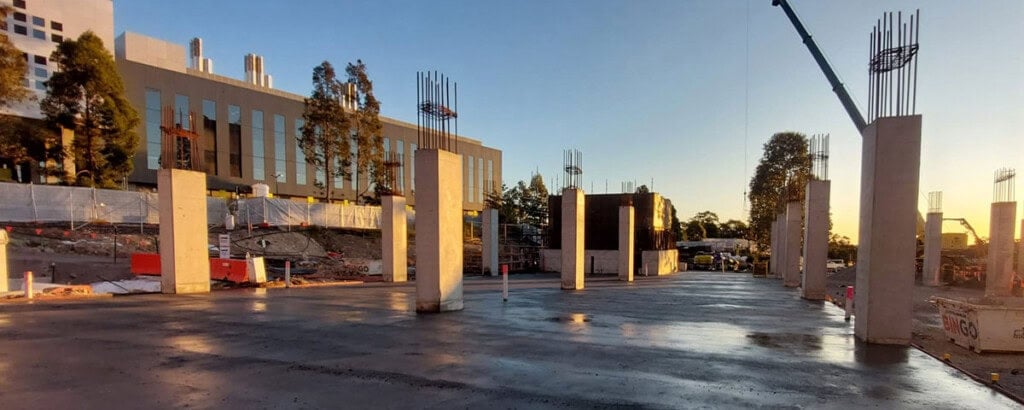
MARKHAM treated areas of the building’s slabs with a penetrating curing treatment instead of a film-forming compound.
Construction of the building is now complete, with patients expected late in 2026.
 |
| Concrete slabs and columns under construction at John Hunter Hospital, Newcastle |
Questions worth asking
- What floor coverings will go on this slab, and what does their manufacturer require of the substrate?
- Does our curing method leave a film? If so, who removes it, when, and at what cost?
- Has the curing product been confirmed in writing as compatible with the flooring adhesive?
- How will we prove the slab was cured properly?
Talk to us before the curing method is locked in
Whether it’s a new hospital, an extension, aged care or a laboratory, curing is settled at specification, not when the flooring crew arrives.
Talk to MARKHAM before the curing specification is locked in. We can review the slab finish, curing method and flooring requirements with your project team.
Hospital concrete cured!