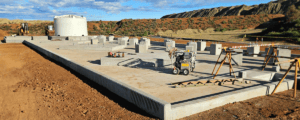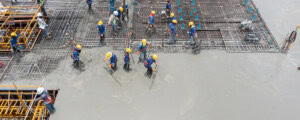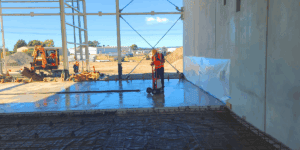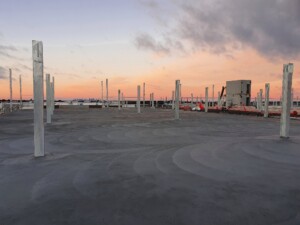
It’s an insider joke … ‘air curing’ means leaving the concrete to cure itself without any intervention or enhancement. No extra water, no treatment added, no blanket protection – nothing.
Is this a good idea? Well, it’s cheap. But it might also be described as dodgy.
Doing nothing is not an option
Not caring for the concrete at curing stage will almost certainly lead to premature deterioration of that concrete. Early ageing. Early rebar corrosion. Concrete cancer.
Poor curing remains a major issue across the construction industry in Australasia. Concrete that is allowed to dry in air will gain only 50% of the strength of continuously moist-cured concrete.
“Air curing” is not an option.
Construction Note from Access Canberra
In 2023, the Access Canberra Construction Occupations Registrar released Construction Note 2023/03 “Concrete Curing Requirements”.
“Access Canberra building inspectors have identified issues relating to incorrect curing of concrete on several building sites in the ACT, particularly with respect to floor slabs (both on grade and suspended) in class 2-9 buildings. In many cases the builder was unaware of the curing requirements detailed on the plans and or specification, and generally not following good industry practise.
This demonstrates a lack of understanding about the practices which need to be followed to achieve structurally adequate and durable concrete. To assist builders in meeting these requirements, Access Canberra has prepared the following Construction Note to summarise the minimum requirements to achieve compliance.”
The full Construction Note is valuable reading for the concrete construction industry across Australia and New Zealand. It’s great to see the favourable inclusion of water curing as a key methodology, and the correct contextual discussion of AS3799 (relevant to membrane curing).
The Registrar’s Construction Note is available to download here.
Avoid Risk, Safeguard Your Professional Brand
Have you evaluated the real cost of concrete curing … or rather, of not looking after the curing?
Did you know that concrete curing is typically included in architectural specifications as a mandated requirement? This means if you’re failing to properly cure the concrete, you’re in breach of the requirements of the specification.
- TECHNICAL DATA: CONQOR CURE – download
This is not just about the concrete; it’s also about the overall quality and longevity of the project. By extension, it’s about your professional brand and about avoiding long-term risk. This is true for the construction team, and it’s also true for the asset owner or developer – no one wants potential deterioration built into the structure.
Another thing we see happening – where site teams are worried about compatibility with later finishes – curing processes may be omitted or watered down in an attempt to avoid conflict with other trades on site.
What Does Poor Curing Really Cost?
- Reduced durability
- Increased cracking risk
- Remedial work
- Delays
- Disputes
- Reputational damage
And then there are recent developments to consider: lower-carbon concrete and the increase of SCMs.
As concrete mixes evolve to meet sustainability and performance objectives, effective curing becomes increasingly important to help concrete achieve its intended performance.
 |
Do you know what? It’s not that hard!
Caring for concrete curing is really straightforward.
And hey, MARKHAM can make it even easier! We’d like to tell you about a better, simpler approach. We can help you comply with specification requirements and meet government technical standards.
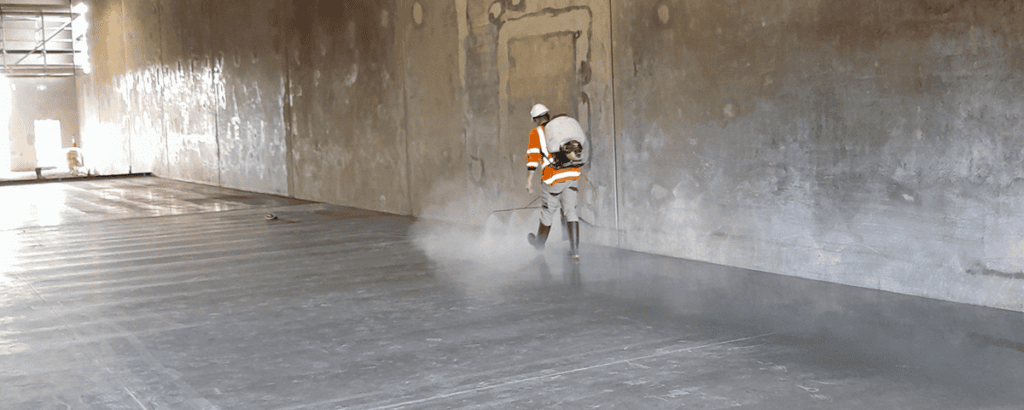
CONQOR CURE was developed to make curing simple, practical and compatible with modern construction workflows. Independent testing confirms curing performance equivalent to that of water curing and AS3799 membrane curing systems when applied in accordance with the recommendations.
Have you ticked all the boxes?
Whether you’re using water curing, membrane curing or hydrogel curing, our team can help assess your approach against specification requirements and project objectives.
Talk to a curing specialist.
One other thing
There are a lot of curing compounds which will cost you more in grinding and labour than they did to put down. These compounds are supposed to break down over the course of the project, and sometimes (often?) that just doesn’t happen.
 |
| You don’t want to be faced with crazed, hardened curing compound at the end of your project. |
That’s why MARKHAM recommends hydrogel curing treatment. Cure – seal – harden. High quality concrete from day one and for the long term.
More on this topic? Try our on-demand webinar, “Concrete Curing for Today and Tomorrow“.