Water curing is the benchmark. Can your site deliver it every time?
For site managers, PMs and specifiers: the best curing method on paper is only as good as the hours nobody is watching.
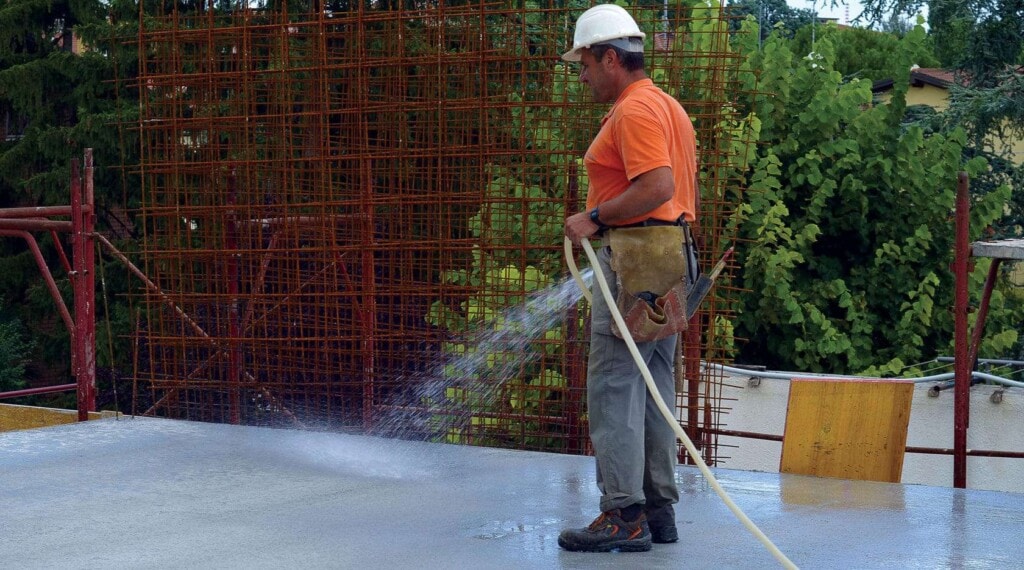
Ask most engineers about the benchmark for curing concrete, and water curing will likely come up. That is, keep the surface continuously wet, and the cement keeps hydrating, building strength and a dense, durable surface.
Now picture day three of the cure. The sprinklers were moved so the formworkers could get through. A hose kinked overnight. A hot northerly dried the edges by lunchtime, and on Saturday nobody was on site.
The slab looks fine. Whether it was actually cured to the benchmark is another question, and one that is rarely recorded.
Why water curing is hard to deliver consistently
Water curing works because it never lets the surface dry out. That is also its weakness. It has to be continuous for the whole specified curing period, and every interruption counts. Depending on the concrete specification and conditions, water curing may need to be maintained continuously for several days, commonly around seven days.
On a real construction site, it competes with:
- other trades needing access to the slab
- wind, heat and low humidity drying the surface faster than water is replaced
- nights and weekends with nobody checking
- water supply, runoff and wet-surface safety.
There’s also the paperwork. Once the hoses are gone, a water cure is hard to prove.
 |
The usual alternative
Film-forming curing compounds to AS 3799 may seem easier: one spray and done. But the film sits on the surface and can interfere with later coatings, toppings or floor coverings, so it may need to be removed first.
That leaves many teams choosing between the method that performs best and the one they can realistically deliver.
- RELATED TOPIC: The Concrete Curing Cost Nobody Quotes For
The MARKHAM approach
MARKHAM hydrogel treatments are water-based and work inside the concrete rather than forming a film on it. They react with the water and free compounds already in the slab, helping hold moisture where hydration needs it.
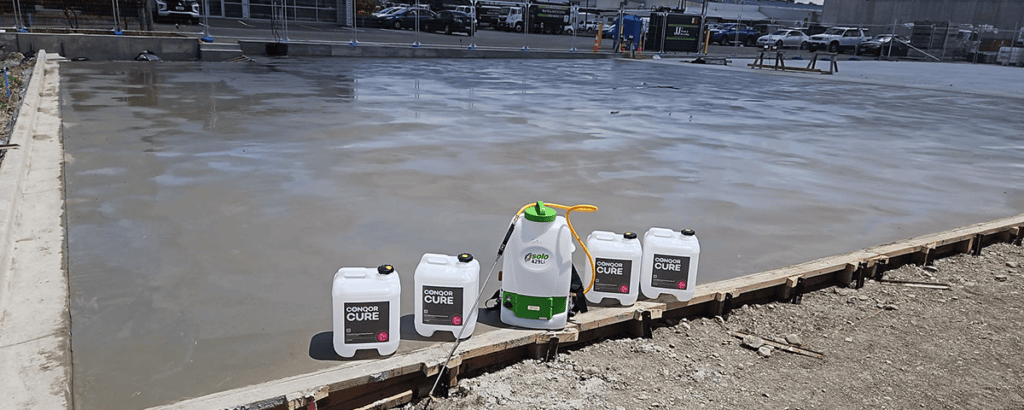
CONQOR CURE is sprayed once after finishing. Independent testing by Cement Australia found CONQOR CURE delivered curing performance equivalent to both water curing and an AS 3799 film-forming membrane. The comparison covered strength development, temperature, internal relative humidity and chloride resistance (ASTM C1202).
Because it leaves no residue, there is nothing to remove. It is compatible with coatings and adhesives designed for bare concrete, including direct-stick floor covering adhesives.
In short, it gives you the benchmark result from a single application that does not depend on someone moving the hoses on a Saturday.
- ANOTHER CHALLENGE: Hot, dry and windy: will your slab survive its first 24 hours?
 |
Questions worth asking before your next pour
- Who checks the water cure overnight and at weekends?
- How will you show the slab was cured for the full specified period?
- Will a curing membrane need removing before coatings or floor coverings go down?
- What independent test data supports the curing method in your specification?
Talk to us before the curing method is locked in
Planning slabs, suspended floors or pavements? Talk to a MARKHAM curing specialist about achieving water-cure performance from a single application.
The CONQOR CURE technical data sheet is available for download.
Concrete curing is an investment in its long-term durability. Learn more in our on-demand webinar “Concrete Curing for Today and Tomorrow“.