A new data hall is nearly ready. Cable trays are in, racks are arriving. At some point the concrete gets a final coat of sealer to prevent dusting. It looks clean and finished.
What rarely gets asked is what that sealer coat is made of, and what it does in a fire. Spread across thousands of square metres, even a thin film adds up.
Years later, it wears and gets recoated. Each layer adds a little more.
- RELATED READING: Fire Risk: A Major Concern for Data Centres
Why the concrete finish matters to fire load
Fire load is the total energy that could be released if everything combustible in a space burned. Fire engineers use it to design suppression, compartments and escape routes. Servers, cabling and batteries already bring plenty.
Concrete itself is non-combustible. What sits on top of it may not be.
Topical coatings
Topical coatings such as epoxy, polyurethane and acrylic systems form a film on the slab surface. Depending on their formulation and fire classification, that layer may need to be considered as part of the combustible material introduced into the space. That makes the product’s fire classification worth checking, particularly across thousands of square metres of data-hall floor.
Many topical coatings also need periodical recoating, a challenging requirement in an operational data hall.
Penetrating treatments
A penetrating treatment works inside the concrete rather than sitting on it. With no surface film, there is no layer to burn, peel or replace.
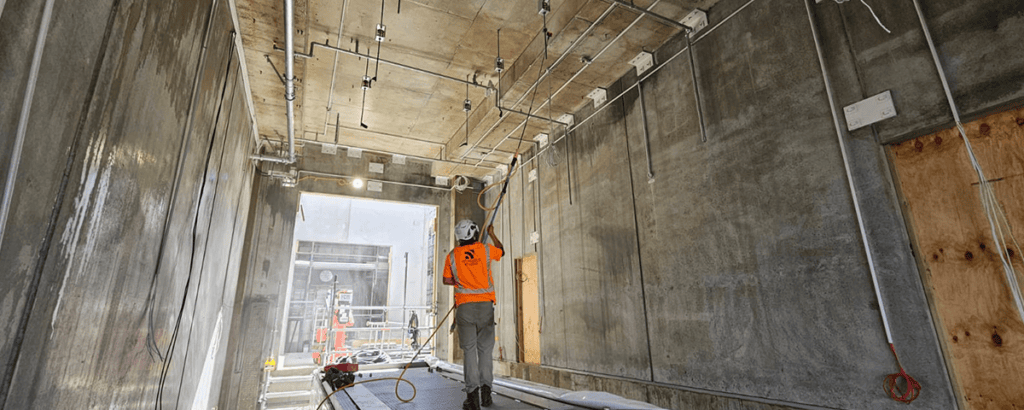 |
| MARKHAM applicator in action at a data centre project in Auckland NZ |
The MARKHAM approach
MARKHAM hydrogel treatments are sprayed onto the concrete and react with the water and free compounds already in the slab. They create more of concrete’s own binding structure (C-S-H, the “glue” in cement paste), closing pores, immobilising moisture and preventing carbonation – the slow chemical change that leads to surface dusting.
For data centres, CONQOR PROTECT carries the independent proof. It has been tested to BS EN 13501-1 using ISO 1182 (non-combustibility) and ISO 1716 (heat of combustion). No flame retardants are used.
CONQOR PROTECT also seals and hardens the surface against dusting without changing its appearance. Because the treatment works within the concrete rather than leaving a sacrificial surface film, it does not require a conventional coating recoat cycle around live equipment.
Timing helps too. On projects where a conventional coating would otherwise be applied later in the programme, treating the concrete during the curing stage can remove weeks from that sequence.
In practice
At Project Gemini Data Centre in Takanini, Auckland (5,001–10,000 m²), MARKHAM waterproofed the concrete mix with hydrogel admixture, then cured and anti-dust sealed the slabs with spray-applied hydrogel treatment. The aim was to protect moisture-sensitive server halls against leaks and reduce lifetime maintenance.
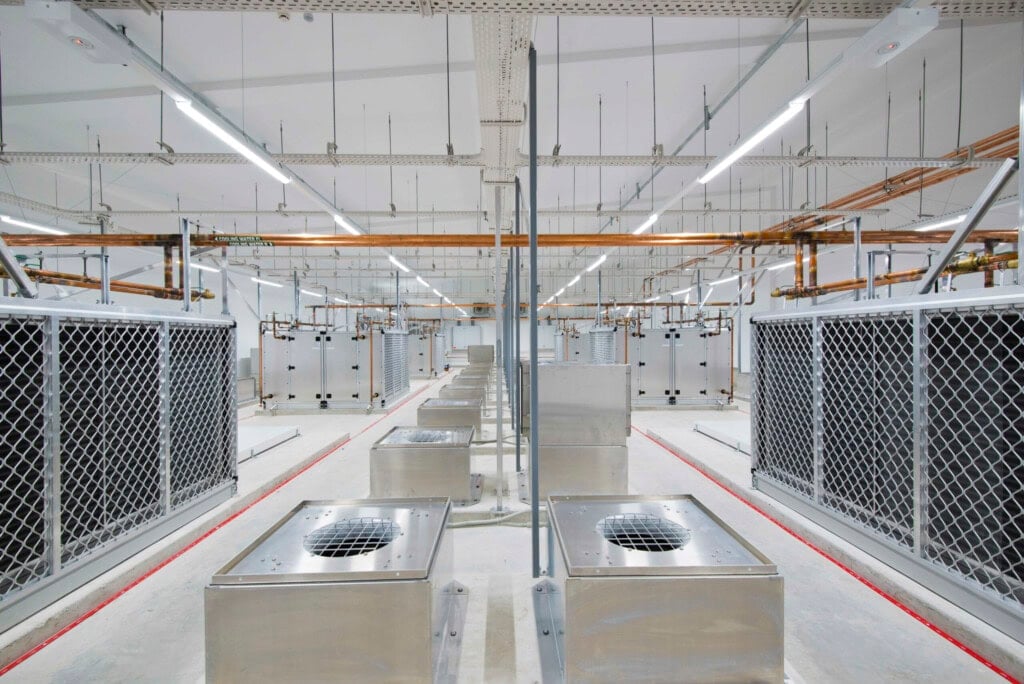 |
| Project Gemini Data Centre |
At the Surfside EC4 data centre in Eastern Creek, NSW, the construction programme required a moisture-control solution that would address these risks without introducing additional curing periods, recoating requirements, or surface‑applied barriers that could slow progress.
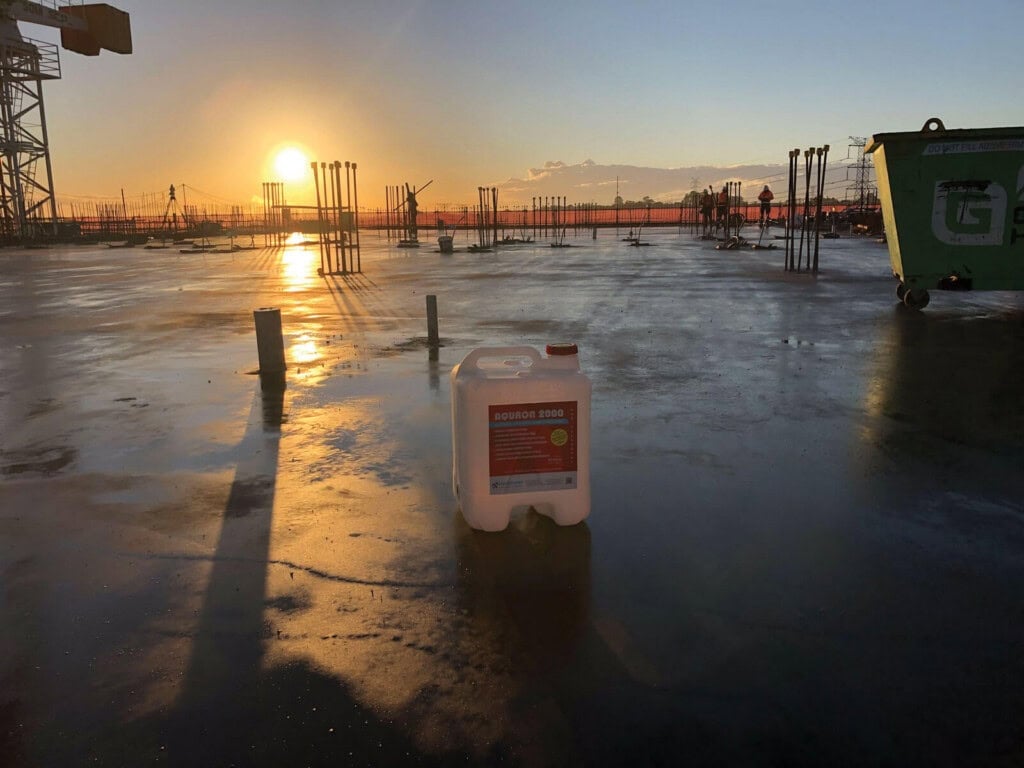 |
| Download the Surfside EC4 case study |
Questions worth asking, before your next data centre project
- Has the fire engineer counted floor finishes in the fire load?
- How often will the coating need recoating, and can that happen in a live hall?
- Could dust control be built into the concrete at pour instead?
- What independent test reports can the supplier provide?
Talk to us before the concrete finish is locked in
Designing or upgrading a data centre? Send us the proposed slab finish or specification. A MARKHAM data centre concrete specialist can review the approach for dust control, durability, maintenance and relevant fire-performance considerations.
More learnings from our on-demand webinar, “Unseen Risks: Concrete in Data Centres“.