
Ever been involved in building a warehouse? You can probably skip over some of this preliminary stuff; you know it already.
Warehouse floors are under daily threat. With trucks, forklifts, and plain old deadweight loads on pallet racks, a warehouse floor needs to be extremely robust.
And flat! Smoothness, even levels, and minimalist joints are all important for ensuring the floor won’t affect vehicle activity. And that’s taken to the next level for an autonomous mobile robot (AMR) warehouse.
Pouring and Finishing the Floor
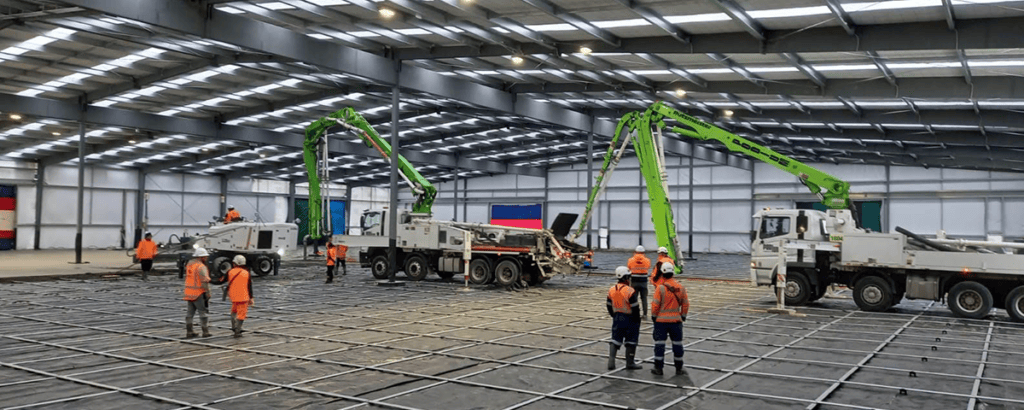
So when a warehouse floor slab is placed, there are a few steps which wouldn’t be found, say, in a car park or retail scenario. Depending on the project, once the concrete is poured, the procedure might look like this:
- Laser screed.
- In some instances, excess water may be squeegeed off.
- Ride on trowel machine with pans for a few passes.
- If fibre reinforced, protruding fibres are removed after each pass.
- Medium speed trowel – a few passes.
- High-speed trowel for a few passes to bring up the sheen by tightening the surface pores.
This makes for a dense slab with a tough upper layer.
- RELATED TOPIC: Why are you using chlorinated rubber?
Surface Hardeners
Oh, we left something out of that list. At some point in that schedule, a surface hardener will probably be used. These are intended to increase the hardness of the slab’s upper surface. There are a few commonly used methods.
- Chlorinated rubber has been popular for its low cost, but is increasingly being rejected due to its high VOC content, environmental impact, and safety concerns.
- Dry-shake hardeners can be applied to the surface by hand or by mechanical means. These are a mix of cement and admixture. Their main drawback is that they only create a shallow crust of hardened concrete. This increases the risk of cracking and delamination later in the slab’s life.
- Lithium silicates can be applied in liquid form. These have the advantage of being very cheap, but again, do not penetrate deeply.
| EXPLAINER: Silicate vs Silica |
|---|
| Silicates are whole-molecule chemicals with minimal reactivity. Their penetration into concrete depends solely on the concrete’s porosity and usually does not exceed 15mm. |
| Silica is a reactive element. In the context of concrete treatments, it can be introduced as a water-borne colloid, or half-molecule, which then reacts with the calcium in the concrete, being drawn very deeply into the slab. More about this shortly. |
Some of the pain points experienced by contractors with these methods include
- May be non-compliant with green building requirements. (e.g. chlorinated rubber)
- May be hazardous or even carcinogenic due to concrete dust or titanium oxide. (e.g. some dry shake mixes)
- Typically provides a poor slab finish.
- Inconsistent application is a common issue.
- Ineffective durability due to shallow treatment.
Let’s Talk About Hydrogel Treatment.
You saw that coming a mile off, didn’t you?!
OK, here it is in a nutshell.
1) Nanoparticle silica colloid, with the appropriate catalyst, induces a hydrogel formation within concrete.
2) This closes the porosities, immobilises the moisture, and protects the reinforcing.
What this means for you and your warehouse floor:
- A truly, madly, deeply hard floor slab. (well, maybe not madly, but you get the idea)
- Restores moisture to the surface, where it may have been depleted by trowelling, helping complete the curing process.
- Enhanced curing regardless of trowelled condition, with minimal shrinkage cracking.
- Provides ideal substrate conditions for buffing or polishing, depending on the screed quality.
- Long-term durability and concrete dust reduction.
Hydrogel treatments are at the core of MARKHAM’s warehouse floor solutions and the SLAB-TECT® approach. We supply and apply, which makes things very easy for you as a client.
 |
And There’s More … Much More.
MARKHAM’s full service includes supply, application, and quality-control documentation. This underpins our performance-based warranties. Yes, you read that right. If we’ve handled the process throughout with our quality control system, we can offer a performance-based warranty, not just a like-for-like product replacement.
Check your suppliers’ quality control processes and warranties! What are they really offering?
Handling the process end-to-end also means you won’t be caught sandwiched between the supplier and the applicator in the event of any mishap along the way.
Our trained applicators give you the confidence that comes with high-quality, consistent results across all projects. This is a key point, given the range of environmental conditions and temperatures in which we work. Different locations may need different approaches.
Quality control documents can be passed straight on to the head contractor, reducing administrative time and costs for you.
And our systems are environmentally friendly! Key products carry Environmental Product Declarations (EPDs). If you’re working on a green build, you know our part is sorted.
What’s not to love? Building a warehouse – get in touch!
More learning on this topic is available in our on-demand webinar, “Warehouse Floors & Naked Concrete“.